

- «Реализация проекта «Добрые игры» в системе дошкольного образования»
- Курс-практикум «Педагогический драйв: от выгорания к горению»
- «Оказание первой помощи в образовательных учреждениях»
- «Труд (технология): специфика предмета в условиях реализации ФГОС НОО»
- «ФАООП УО, ФАОП НОО и ФАОП ООО для обучающихся с ОВЗ: специфика организации образовательного процесса по ФГОС»
- «Специфика работы с детьми-мигрантами дошкольного возраста»


Свидетельство о регистрации
СМИ: ЭЛ № ФС 77-58841
от 28.07.2014

- Бесплатное свидетельство – подтверждайте авторство без лишних затрат.
- Доверие профессионалов – нас выбирают тысячи педагогов и экспертов.
- Подходит для аттестации – дополнительные баллы и документальное подтверждение вашей работы.
в СМИ

профессиональную
деятельность

Main duties of philologist

 555
0
555
0
MAIN DUTIES OF PHILOLOGIST
1) Studies structure and development of specific language or language group: Traces origin and evolution of words and syntax through comparative analysis of ancient parent languages and modern language groups, studying word and structural characteristics, such as morphology, semantics, phonology, accent, grammar, and literature.
2) Identifies and classifies obscure languages, both ancient and modern, according to family and origin.
3) Reconstructs and deciphers ancient languages from examples found in archeological remains of past civilizations.
4) May specialize in study of origin, history, and development of words and be designated Etymologist.
MAIN JOB ROLES (CAREER TASKS):
1) Studies structure development of specific language or language group.
2) Traces origin and evolution of words & syntax through comparative analysis of ancient parent languages and modern language groups, studying word structural characteristics, like morphology, semantics, phonology, accent, grammar and literature.
3) Identifies & classifies obscure languages, both ancient and modern, according to family origin.
4) Reconstructs deciphers ancient languages from examples found in archeological remains of past civilizations.
5) May specialize in study of origin, history, and development of words and be designated Etymologist profess. kin. ..
Identify complex problems and review related information to develop and evaluate options and implement solutions.
Manage own time and the time of others.
Knowledge of laws, legal codes, court procedures, precedents, government regulations, executive orders, organization rules, and the democratic political process.
Ability to listen to and understand information and ideas presented through spoken words and sentences.
Philology is the study of language in oral and written historical sources; it is the intersection between literary criticism, history, and linguistics.[1] Philology is more commonly defined as the study of literary texts as well as oral and written records, the establishment of their authenticity and their original form, and the determination of their meaning. A person who pursues this kind of study is known as a philologist.
In older usage, especially British, philology is more general, covering comparative and historical linguistics.[2][3]
Classical philology studies classical languages. Classical philology principally originated from the Library of Pergamum and the Library of Alexandria[4] around the fourth century BCE, continued by Greeks and Romans throughout the Roman/Byzantine Empire. It was preserved and promoted during the Islamic Golden Age, and eventually resumed by European scholars of the Renaissance, where it was soon joined by philologies of other non-Asian (European) (Germanic, Celtic), Eurasian (Slavistics, etc.) and Asian (Arabic, Persian, Sanskrit, Chinese, etc.) languages. Indo-European studies involves the comparative philology of all Indo-European languages.
Philology, with its focus on historical development (diachronic analysis), is contrasted with linguistics due to Ferdinand de Saussure's insistence on the importance of synchronic analysis. The contrast continued with the emergence of structuralism and Chomskyanlinguistics alongside its emphasis on syntax.
Etymology[edit]
The term "philology" is derived from the Greek φιλολογία (philología),[5] from the terms φίλος (phílos) "love, affection, loved, beloved, dear, friend" and λόγος (lógos) "word, articulation, reason", describing a love of learning, of literature, as well as of argument and reasoning, reflecting the range of activities included under the notion of λόγος. The term changed little with the Latin philologia, and later entered the English language in the 16th century, from the Middle French philologie, in the sense of "love of literature".
The adjective φιλόλογος (philólogos) meant "fond of discussion or argument, talkative", in Hellenistic Greek, also implying an excessive ("sophistic") preference of argument over the love of true wisdom, φιλόσοφος (philósophos).
As an allegory of literary erudition, philologia appears in fifth-century postclassical literature (Martianus Capella, De nuptiis Philologiae et Mercurii), an idea revived in Late Medieval literature (Chaucer, Lydgate).
The meaning of "love of learning and literature" was narrowed to "the study of the historical development of languages" (historical linguistics) in 19th-century usage of the term. Due to the rapid progress made in understanding sound laws and language change, the "golden age of philology" lasted throughout the 19th century, or "from Giacomo Leopardi and Friedrich Schlegel to Nietzsche".[6] In the Anglo-Saxon world, the term philology to describe work on languages and literatures, which had become synonymous with the practices of German scholars, was abandoned as a consequence of anti-German feeling following World War I.[citation needed] Most continental European countries still maintain the term to designate departments, colleges, position titles, and journals. J. R. R. Tolkien opposed the nationalist reaction against philological practices, claiming that "the philological instinct" was "universal as is the use of language".[7][8] In British English usage, and in British academia, "philology" remains largely synonymous with "historical linguistics", while in US English, and US academia, the wider meaning of "study of a language's grammar, history and literary tradition" remains more widespread.[9][10] Based on the harsh critique of Friedrich Nietzsche, US.


БЕСПЛАТНО!
Для скачивания материалов с сайта необходимо авторизоваться на сайте (войти под своим логином и паролем)
Если Вы не регистрировались ранее, Вы можете зарегистрироваться.
После авторизации/регистрации на сайте Вы сможете скачивать необходимый в работе материал.
- «Использование системы альтернативной и дополнительной коммуникации в работе с детьми с ОВЗ»
- «Применение элементов прикладного анализа поведения (ABA-терапии) в работе с детьми с РАС»
- «Организация групповой психологической работы с детьми дошкольного возраста»
- «Обучение скорочтению: содержание работы с детьми школьного возраста»
- «Реализация ФГОС образования обучающихся с умственной отсталостью: специфика организации инклюзивного процесса для лиц с ОВЗ»
- «Адаптированные образовательные программы: разработка и реализация в соответствии с ФГОС СПО»
- Физическая культура. Педагогическая деятельность по проектированию и реализации образовательного процесса
- Педагогическое образование: теория и методика преподавания информатики
- Педагогика и методика преподавания биологии в образовательной организации
- Организация и содержание деятельности младшего воспитателя в дошкольном образовательном учреждении
- Преподавание в организации среднего профессионального образования
- Деятельность няни в рамках социального обслуживания населения: теоретические и практические основы

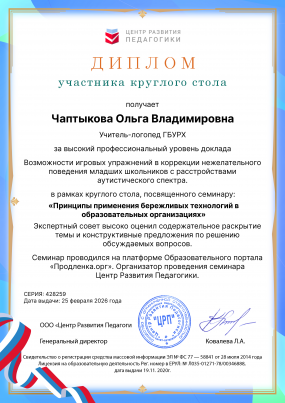


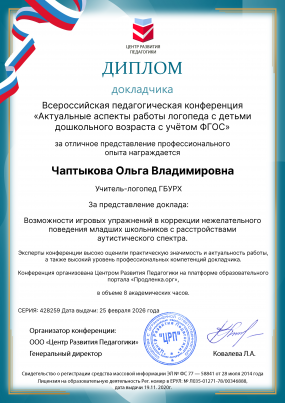


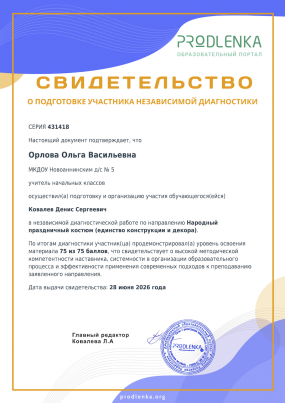





Чтобы оставлять комментарии, вам необходимо авторизоваться на сайте. Если у вас еще нет учетной записи на нашем сайте, предлагаем зарегистрироваться. Это займет не более 5 минут.